INSTALLATION INSTRUCTIONS
The following provides guidance on how to install the R7.0 ceiling batt. The following installation instructions support the use of the R7.0 ceiling insulation. It provides examples at 20˚ and 25˚ roof pitches using a 90 and 105mm heel heights. These calculations can be used as conservative values when making energy performance calculations.
With increased thermal performance requirements and 7 star homes becoming the modern standard there is a requirement for High R-value ceiling products and systems to achieve maximum performance in the ceiling space. Using these products with a baffle / insulation barrier at the eaves will also maximise the performance at the perimeter, without the need for a heel truss. Using Knauf Insulation’s R7.0 significantly lifts the thermal performance of the ceiling and the thermal values at the perimeter, making it a great choice when you are trying to achieve 7 star ratings.
Tools required:
- Sharp knife for trimming insulation
- Ladder
- Suitable clothing (see our Health and Safety Information)
- Tape measure
- Non-conductive insulation stick for positioning insulation in hard to reach areas
- Kneeling board to span ceiling framing
BEFORE YOU START
- Determine the most suitable product for your project. Ceilings can be insulated using ceiling batts, blankets and rolls.
- Where you have existing insulation that is level with the ceiling joists, you can install additional insulation over the top. It is recommended that this is installed at right angles to the existing insulation.
- Insulation is available in varying widths and thicknesses to suit most framing spaces. Please check www.knaufinsulation.com.au for the most suitable product for your application.
- To calculate the number of packs needed, determine the area (m2) to be insulated by multiplying the length by the width or wall height. The number of m2 of insulation material is clearly marked on each pack. Divide the total area to be insulated by the m2 in a pack to determine the number of packs required (don’t forget to round up to the nearest whole pack). Allowances should be made for areas that are unable to be insulated.
- Don’t take the insulation out of the packaging until you’re in a position and ready to install.
- Before installation, gently agitate the insulation by gently shaking or bouncing it on its side until it recovers to the thickness stated on the label.
- Do not block ceiling vents and take care around downlights and other sources of heat. Consult the manufacturer’s instructions for appropriate clearances. Additional guidance is provided in AS 3999.
TRUSS ROOF / INSTALLATION FROM BELOW
- Release the insulation from the packs.
- Lightly bounce the slabs on their side to invigorate the insulation and help it recover to its 330mm nominal thickness. • Feed the product up through the ceiling battens and position the insulation on top of the ceiling battens and against the truss cord.
- Gently push the ceiling batts against the truss to encourage them to fit around the timbers while creating room for the next ceiling batt to be installed beside it.
- Repeat the process, installing the other ceiling batts in a similar way, paying attention to all the joins between the slabs and timbers to ensure a tight and neat fit.
- Once a truss bay is completed it is recommended that you inspect from above to see that the top surface is smooth and consistent, lifting the ends and sides of the batts to ensure a tight and neat connection before moving to the next truss bay.
- Repeat this process until all truss bays are completed.
- When installing insulation in the eave (i.e. the junction between the roof, wall and ceiling), make sure the insulation covers the top plate but is not in contact with the roof. It is important to maintain a 25mm gap between the roofing substrates and the insulation.
- Do not block ceiling vents and take care around downlights and other sources of heat. Consult the appliance manufacturer’s instructions for appropriate clearances. Additional guidance is provided in NZS 4246.
- Try to fit insulation behind pipes or other obstructions unless this would compress the insulation. If so, cut the insulation to fit around objects, beams or other barriers.
RETRO FIT / INSTALLATION FROM ABOVE
The following details the R7.0 Ceiling batts compressed into the eaves with the use of a barrier to achieve a high performance at the eaves. Knauf Insulation’s R7.0 product has been designed with a nominal density which allows the product to be easily compressed into the eaves. The following provides guidance and a calculation of the thermal performance in roofs with a roof pitch of ≥ 20º.
RETRO FIT / INSTALLATION FROM ABOVE
The following details the R7.0 Ceiling batts compressed into the eaves with the use of a barrier to achieve a high performance at the eaves. Knauf Insulation’s R7.0 product has been designed with a nominal density which allows the product to be easily compressed into the eaves. The following provides guidance and a calculation of the thermal performance in roofs with a roof pitch of ≥ 20º.
Install Instructions
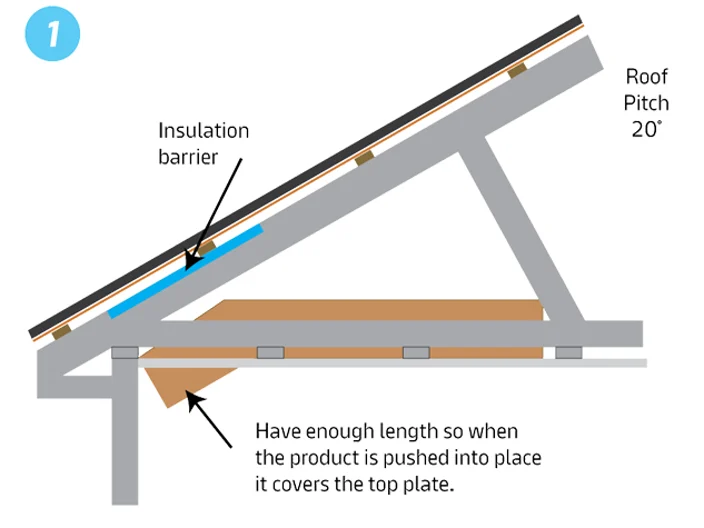
- If the eave barrier has not already been installed, cut the barrier between the truss timbers and staple into place.
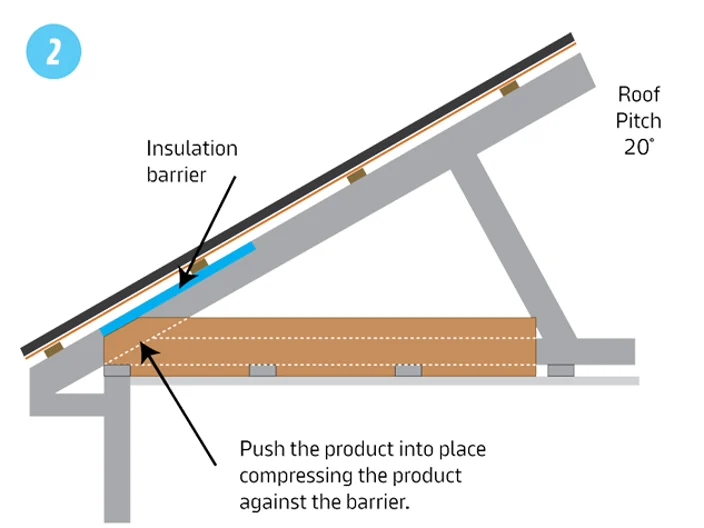
- Running the ceiling batts length parallel with the truss, slide the ceiling batt into the eaves. The following two step procedure can help with this process.
- The ceiling batts can also be installed with the length of the product parallel to the eave if required.
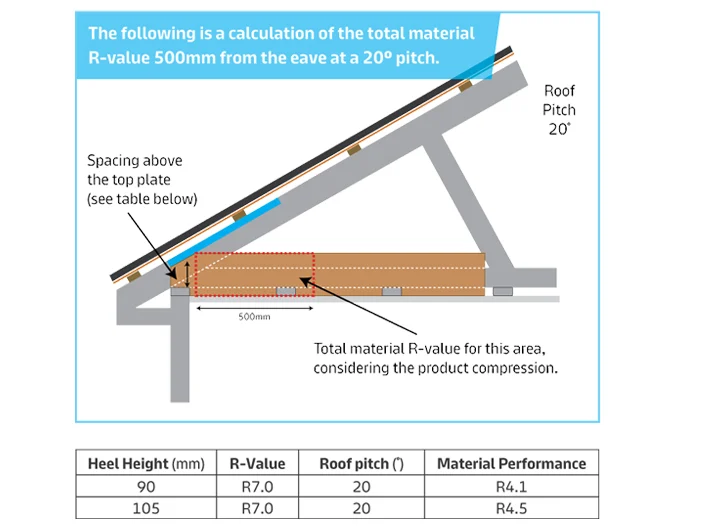
THERMAL CALCULATION (20 Degree Roof Pitch)
The values are material values and should be used to determine the construction R-values.
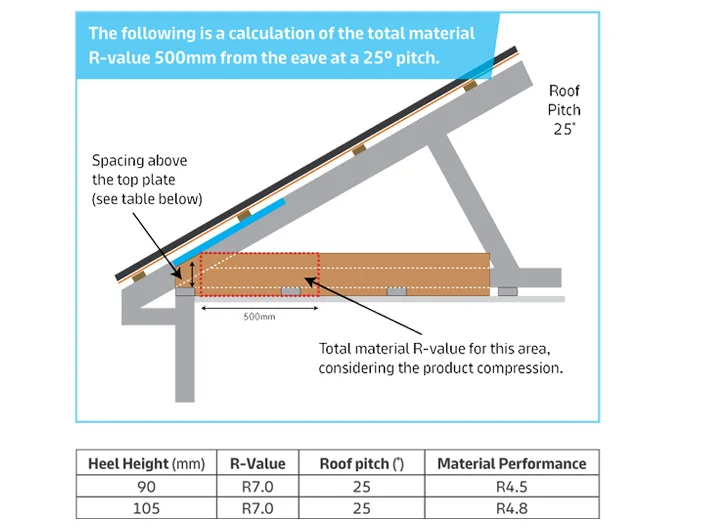
THERMAL CALCULATION (25 Degree Roof Pitch)
The values are material values and should be used to determine the construction R-values.
RETRO FIT / INSTALLATION FROM ABOVE
- When retrofitting ceilings you must turn the power ‘Off’. A torch or adequate lighting will be required. Step / kneeling boards can be used to help with access, especially in truss roof designs. A wooden, non-conductive positioning rod (1-2 metres long) can assist in insulating eaves or hard to reach areas.
- Ensure you have the right product for the application. Check the thermal resistance rating (R-value) required on the drawings / plans and that this matches the product selected. Check the condition of the roof ensuring that it is watertight repairing any damage to the roof sarking.
- Start installing the insulation at the far corners of the roof and work your way back towards the ceiling access.
- When installing insulation between ceiling joists, ensure that you achieve a snug fit avoiding any gaps (we recommend installing between the ceiling timbers and in contact with the ceiling linings. For installs over timbers refer to AS 3999 for guidance).
- When installing insulation in truss roofs, ensure that insulation is firmly butted together to achieve a consistent layer of insulation without any gaps.
- Where required, use a sharp knife to cut the insulation to fit, be careful avoid gaps and maintain a continuous layer. It is important that when you cut the insulation that you avoid coming into contact with any electrical services.
- When installing insulation in a roof eave (i.e. the junction between the roof, wall and ceiling), make sure the insulation covers the top plate but is not in contact with the roof. It is important to maintain a 25mm gap between the roofing substrates and the insulation.
- Once you have worked your way back to the ceiling access, make sure you insulate the ceiling access panel before exiting the roof space.
- Always take extra care while moving around in a ceiling space. Ensure sound footing at all times. Only use roof trusses or ceiling joists for support and never stand on ceiling plasterboard.
- Watch out for nails — especially in ceilings where roofing nails may protrude through the sheathing.
- To make access across the roof space easier, use kneeling boards. Place boards over roof trusses or ceiling joists to make a path.
- Do not take the insulation out of the packaging until you’re in position and ready to install. Before installation, gently invigorate the insulation by ‘bouncing’ it on its side until it recovers to thickness stated on the label.
- Do not block ceiling vents and take care around downlights and other sources of heat. Consult the appliance manufacturer’s instructions for appropriate clearances. Additional guidance is provided in AS 3999.
- Try to fit insulation behind pipes or other obstructions unless this would compress the insulation. If so, cut the insulation to fit around objects, beams or other barriers.
WHERE YOU HAVE EXISTING CEILING INSULATION
When you are topping up existing insulation you may want to establish the thermal value of the existing insulation. A contribution of R0.2 for every 10mm of existing insulation is a conservative approach.
Once you have determined your existing insulation levels, install Earthwool® insulaton with a suitable R-value to achieve the desired thermal performance. (allowance should be made for a slight compression of the lower layer)
Place the insulation over the existing insulation at right angles to the ceiling joists ensuring a consistent layer with no gaps or voids. • For further guidance of retrofit solutions refer to AS 3999.
CATHEDRAL/SKILLION ROOFS
- Where cavity depths allow the R7.0 product can be used in skillion roofs, take care to ensure that the 25mm gap between the insulation and the roof is maintained.
- For smaller cavities refer to the range Skillion roof products designed for this application.