
The Australian Building Code Board (ABCB) is a Council set up by the Australian State and Territories governments to produce and maintain The Building Code of Australia (BCA). The BCA is found in Volumes One and Volume Two of the National Construction Code (NCC) and is produced to set minimal building standards for health and safety, building sustainability and efficiency.
Energy Efficiency Standards
There are minimum standards for energy efficiency in new houses and apartments. These standards are commonly achieved through:
- A house energy rating (commonly referred to as a "star rating" using the Nationwide House Energy Rating Scheme (NatHERS) accredited software);
OR
- Building according to the "Deemed-to-Satisfy" (DTS) provisions of the NCC.
Building a new home is the most economical time to go above and beyond minimum standards and maximise your thermal comfort. It’s also the easiest time to plan and protect yourself from future energy price rises. Be aware of the construction methods that are popular within the region in which you want to build so that you can make the right decision when choosing your insulation product.
Nationwide House Energy Rating Scheme (NATHERS)
The Nationwide House Energy Rating (NatHER) is a Star Rating from 0 to 10 that measures how energy efficient a house is, based on its design. The rating applies to the building envelope: the roof, walls, floor and windows. A well-insulated and well-designed house provides year-round comfort, cutting cooling and heating bills, and reducing greenhouse gas emissions.
National Construction Code 2022
On 26 August 2022, Building Ministers agreed to update the residential energy efficiency standards for new houses and apartments in the NCC 2022. These changes were introduced to improve accessibility for building energy efficient, comfortable, cost-effective homes.
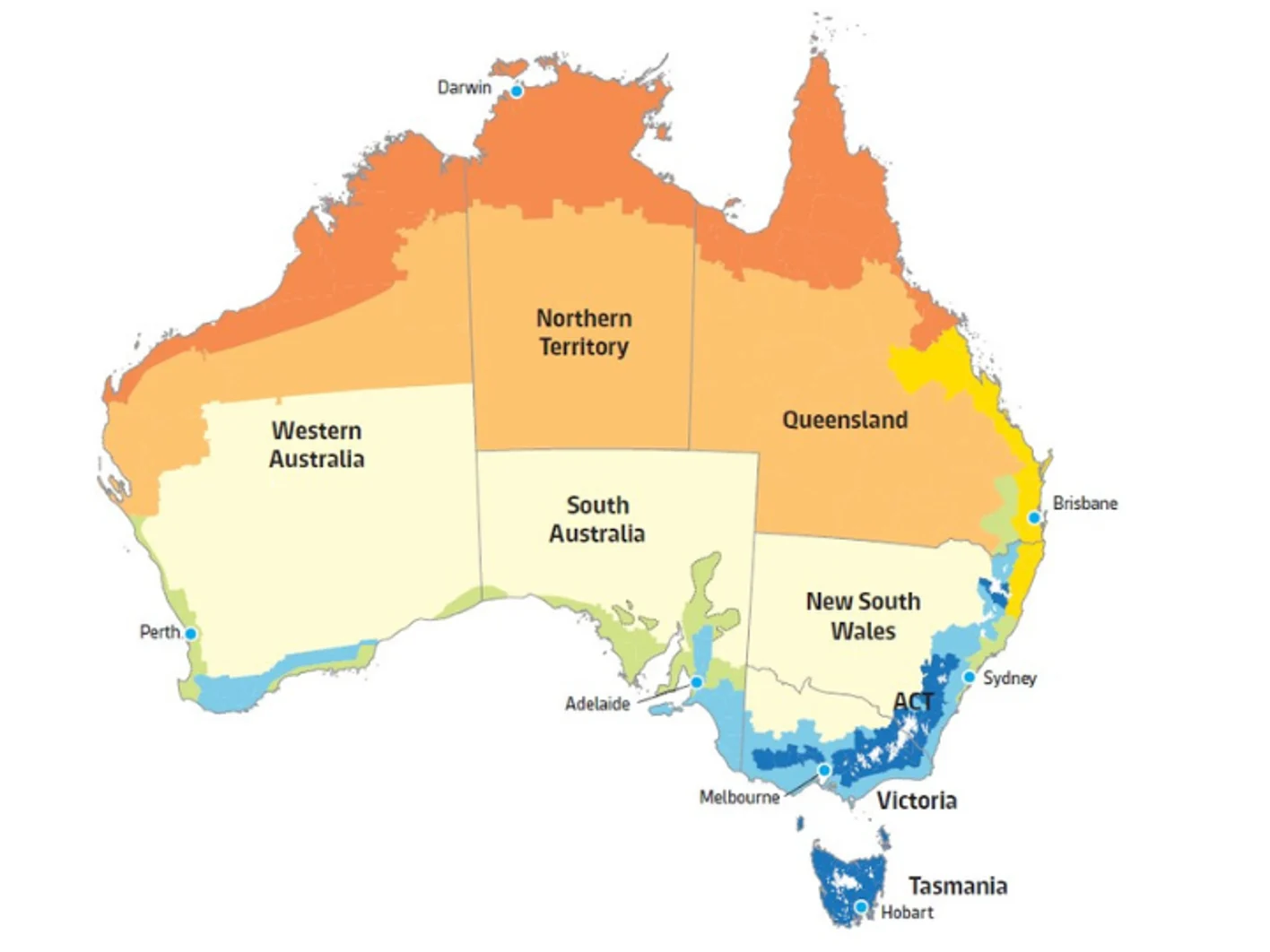
The following table provides an overview of the minimum R-values required for BCA compliance for various applications in each climate zone.
Climate Zone | Light-coloured roof | Dark-coloured roof | Walls | Underfloor |
|---|---|---|---|---|
1 | 4.0 | 5.0 | 2.5 | 2.5 |
2 | 4.0 | 5.0 | 2.5 | 2.5 |
3 | 4.0 | 5.0 | 2.5 | 2.5 |
4 | 4.0 | 5.0 | 2.5 | 2.5 |
5 | 5.0 | 6.0 | 2.5 | 2.5 |
6 | 5.0 | 6.0 | 2.5 | 2.5 |
7 | 5.0 | 6.0 | 2.5 | 2.5 |
8 | 5.0 | 6.0 | 2.5 | 2.5 |
- Our Entities
- Knauf Gypsum
- Knauf Insulation
- Resources
- Products
- Download Center
- Our Services
- Connect with Knauf
- Contact Us
- Blog
- Global Careers