Here, we de-mystify some commonly used terms relating to fire safety and insulation:
APPROVED DOCUMENT B (OR ‘PART B’)
Approved Document B is a government document which provides guidance on meeting Part B (fire safety) of the Building Regulations for England. Approved Document B addresses multiple regulatory requirements, including those relating to means of warning and escape, and internal and external fire spread. The document is divided into Volume 1 (Dwellings) and Volume 2 (Buildings other than dwellings). Both can be viewed and downloaded from the government website.
Note: Regulations set the minimum standards but other organisations such as local authorities, clients and insurers can all influence the requirements of a development. This can result in stricter requirements than are set out in the Building Regulations.
FIRE RESISTANCE
‘Fire resistance’ refers to a system or build-up’s ability to resist, and ideally prevent, the passage of fire from one distinct area to another. Fire resistance helps to prevent the fire from spreading through a building, maintain the structure’s integrity, and enable the safe exit of occupants.
Remember: products that provide fire resistance are extensively tested, so always use a product designed for the application to ensure it will deliver the desired performance.
REACTION TO FIRE
‘Reaction to fire’ refers to the inherent combustibility of a material or system. In other words, how it contributes to the development and spread of a fire by acting as a fuel source.
EUROCLASS CLASSIFICATION
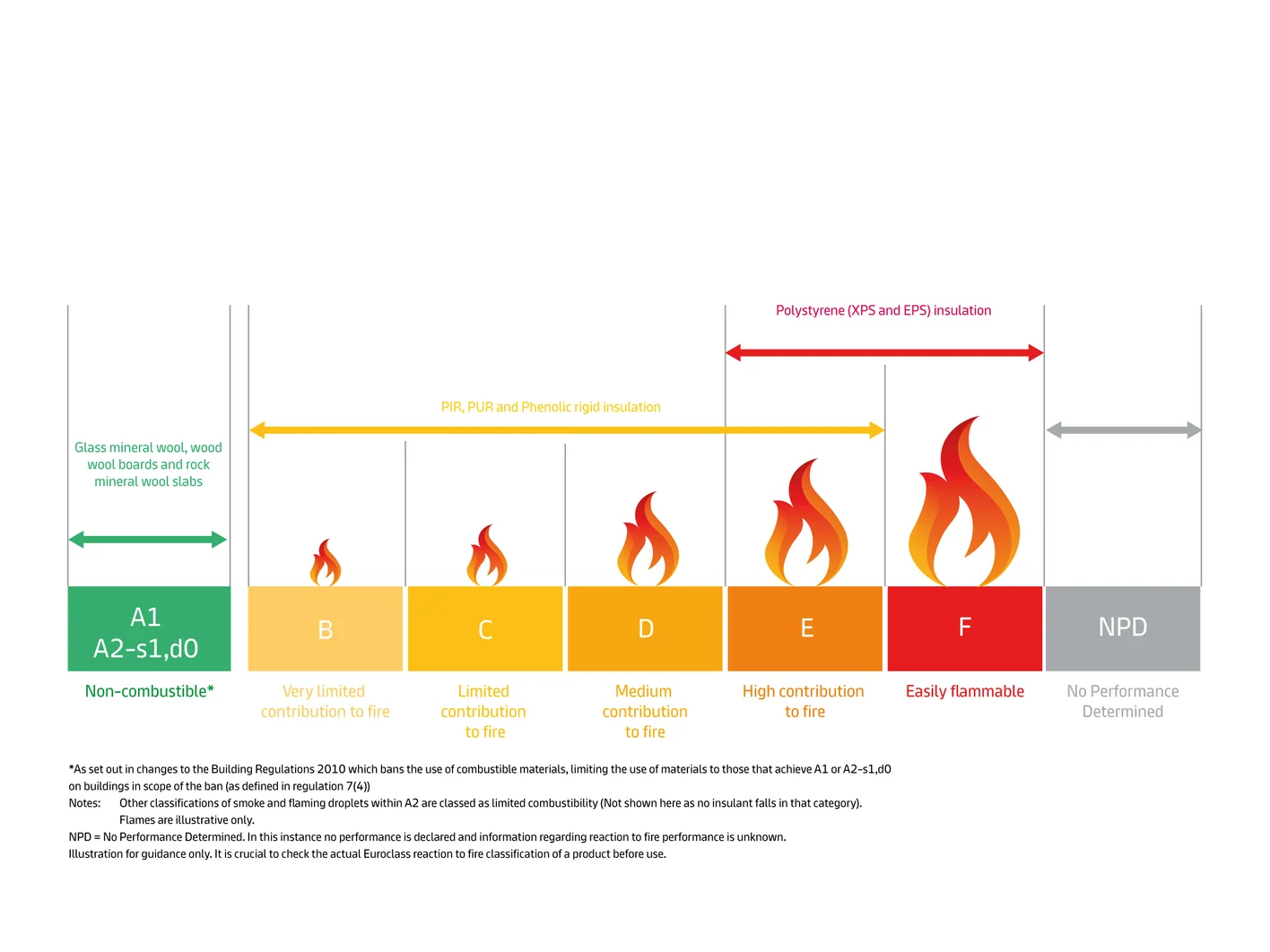
All CE or UKCA marked insulation materials in Europe are given a Euroclass reaction to fire classification against the relevant harmonised standard. This indicates whether the material will contribute to the spread of fire, emit smoke, or produce flaming droplets. The classifications can be broken down as follows:
Contribution to fire: | |
A1 | No contribution to the fire |
A2 | No significant contribution to the fire |
B, C, D | From limited to medium contribution to the fire |
E, F | From high contribution to fire to easily flammable or untested |
Smoke emission (within first 10 minutes of exposure to fire): | |
S1 | Little or no smoke |
S2 | Some smoke |
S3 | A lot of smoke |
Production of flaming droplets (within first 10 minutes of exposure to fire): | |
D0 | No flaming droplets |
D1 | Some flaming droplets |
D2 | Unlimited flaming droplets |
The table below shows how each Euroclass classification contributes to a fire and the common insulation materials that typically sit within each category.
EUROCLASS A1 AND A2-S1,D0
‘Euroclass A1’ products meet the highest possible level of non-combustibility for thermal insulating products when classified to BS EN 13501-1. The ‘A1’ certification means a product is non-combustible and will not contribute to the development of a fire.
Insulation with a ‘Euroclass A2-s1,d0’ classification is considered non-combustible† in accordance with England’s Building Regulations, which ban the use of combustible materials in certain applications, limiting use of materials to those achieving A2-s1,d0 or better.
Euroclass A2-s1,d0 products have no significant contribution to fire, and will produce little or no smoke and no flaming droplets.
Fire safety legislation is complex and different rules apply, depending on the build. The simplest solution is to only use non-combustible products (A1 or A2-s1,d0)†, regardless of the height or use of the building.
All our glass mineral wool, rock mineral wool and wood wool roll or slab products are non-combustible† and achieve Euroclass A1 or A2-s1,d0 reaction to fire classifications.
†As set out in changes to the building regulations 2010 which bans the use of combustible materials, limiting use of materials to those achieving A1 or A2-s1,d0 on buildings in scope of the ban (as defined in regulation 7(4)).