REACTION TO FIRE AND FIRE RESISTANCE
Reaction to fire and fire resistance are two different - but equally important - considerations when it comes to designing a building.

All of our glass mineral wool, wood wool boards and rock mineral wool slabs are non-combustible and offer the best performance when it comes to both Reaction to Fire and Fire Resistance, enabling building designers and specifiers to develop effective and robust fire safety strategies when they design new buildings.
"Under conditions of a fully developed fire, these [A1 and A2-s1,d0] products will not significantly contribute to the fire load and fire growth." - British Standard BS EN 13501: Fire classification of construction products and building elements
REACTION TO FIRE - HOW QUICKLY WILL THE FIRE DEVELOP?
The measurement of how a material or system will contribute to the fire development and spread, particularly in the very early stages of a fire when evacuation is crucial.
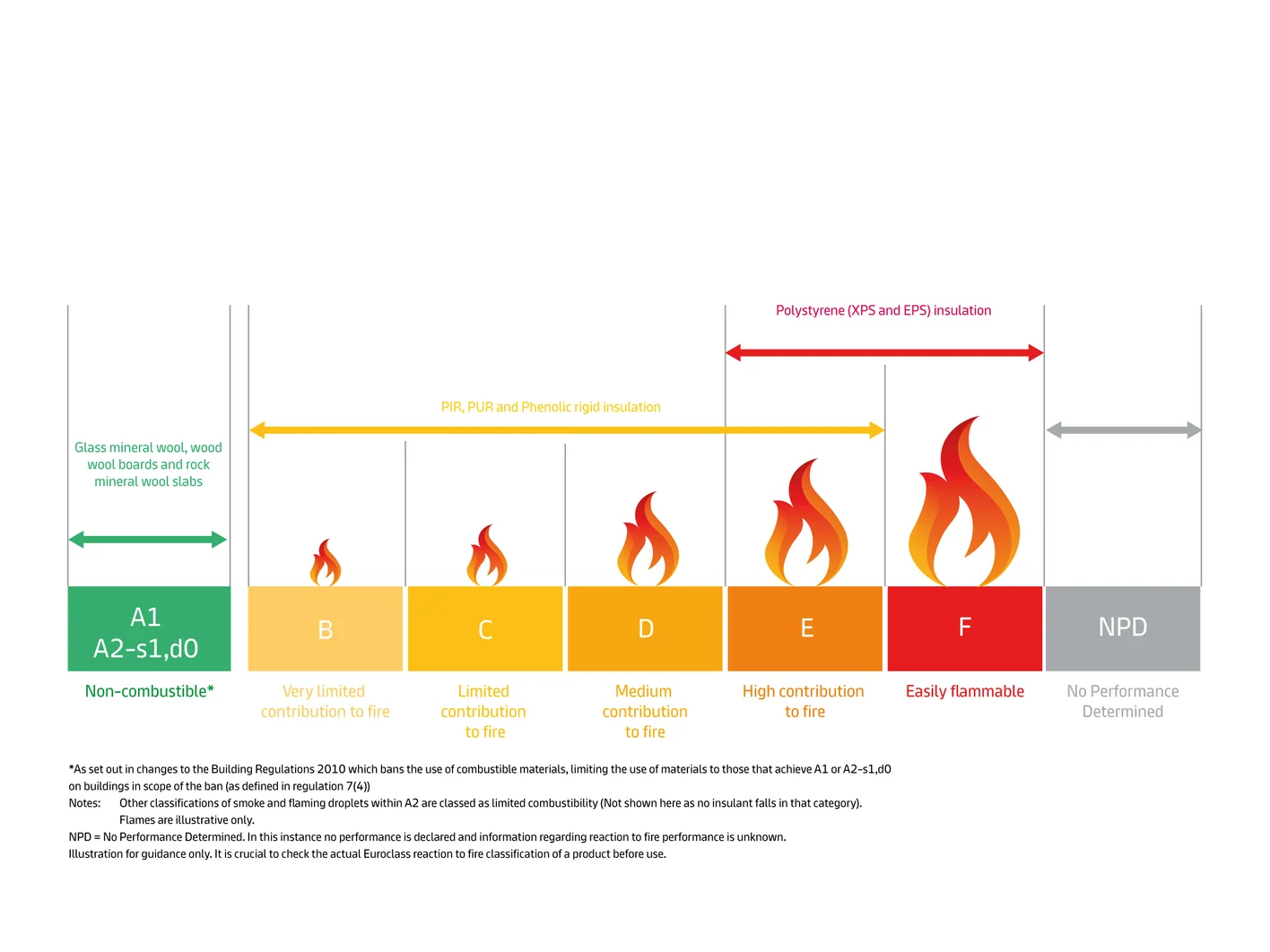
All insulation materials are given a Euroclass reaction to fire classification in accordance with BS EN 13501: Fire Classification of construction products and building elements, helping specifiers to understand how much ‘fuel’ will be added to the building as well as how a material will contribute to the development stages of a fire when evacuation is crucial.
Testing is carried out to determine the performance of materials in terms of fire behaviour, smoke production and flaming droplets, giving a range of classification possibilities.
All of our glass mineral wool, wood wool boards and rock mineral wool slabs are non-combustible and achieve the best possible Euroclass A1 or A2-s1,d0 reaction to fire classification.
By choosing non-combustible insulation materials, building designers and specifiers can design out the risk of fire within the building fabric from the start.
FIRE RESISTANCE - HOW LONG CAN THE CONSTRUCTION WITHSTAND THE FIRE?
The measurement of the ability of a material or system to resist, and ideally prevent, the passage of fire from one distinct area to another. Building Regulations require certain elements such as partitions, separating walls, ceilings and beam and column constructions to provide specified amounts of fire resistance.

Fire protection classifications are normally reported in terms of a period of fire resistance, for example 30, 60 or 90 minutes. These classifications relate to what is known as the integrity (E), thermal insulation (I) and load-bearing capacity (R) of building elements.
Simply, this means how elements — either in combination or individually — stop a fire spreading, how they restrict temperature rise and how the elements’ load-bearing capacity is maintained.
A range of our solutions have been tested for use in a variety of fire-resistant applications, providing fire resistance periods ranging from 30 to 180 minutes to assist the design of safe buildings. Our fire-resistant solutions help inhibit fire spread, maintain structural integrity and limit the spread of fire and smoke from one area to another, providing safe buildings for occupants, and added peace of mind for specifiers.
YOUR NEXT STEPS...
"The drive for improved energy efficiency has introduced large quantities of combustible materials into the built environment by way of structure, cladding and insulation. The protection of this material very often demands encapsulation by better performing materials (such as plasterboard), to a precision that may be difficult to achieve on-site or whose capability may reduce during the life-span of the building.
Non-combustible materials are known to be very forgiving of other key fire relevant challenges such as poor-quality workmanship, structural abuse and wear and tear over time."
- Fire Protection Association