Construction Industry Waste: The hidden cost of our rubbish problem
July 2026
If you’ve seen the Netflix documentary ‘Buy Now! The shopping conspiracy’, you’ll be familiar with the concept that when you throw something ‘away’ – there is no magical place of ‘away’. Waste might disappear from your projects, but where does it end up?
The scale of the problem
The construction leadership council’s 2021 report highlighted that the true cost of waste from new build construction is £11 billion per year with a carbon cost of 3.3 million tonnes/CO₂e per year¹.
Shockingly, the UK Construction Industry Annual Waste Report by Qflow² highlights that 13% of construction materials are diverted to waste without being used. Social enterprises like Recipro aim to avoid this by taking leftover construction materials and selling them at highly discounted rates in their local communities, or to charities or schools.
Waste is generated at all stages of a construction project’s lifecycle, in production, design, delivery to site through packaging, and in construction. We’re therefore all responsible in playing our part to reduce waste.
Plasterboard should be recycled
Plasterboard must be separated from other waste. Although it is not a hazardous waste, if it is disposed of with other biodegradable waste, it can produce a toxic hydrogen sulphide gas.
It should be recycled, as the gypsum can be put back into new plasterboards, and the paper can be recycled separately. If it isn’t recycled, a separate mono-cell landfill site must be used, which can be a very costly option.

We’re working towards our target by working to reduce the waste we produce and working to the waste hierarchy with our waste providers.
Packaging is needed to deliver safe, quality products to site. We are working on reducing any unnecessary packaging and updating the specification of our packaging where possible to reduce environmental impact. This includes changing to recycled content and working to increase the recyclability of products.
The design stage
In the design stage, in an ideal world, projects would be designed to fit the sizes that plasterboard comes in as standard, but we know that can’t always happen. That’s why we offer a bespoke board service, where we can produce different lengths of plasterboard to suit your project, as well as a bespoke cut to length metal service. By having materials produced in the size you need, as well as reducing time on site with cutting, waste from offcuts is reduced. Speak to your local Knauf contact about bespoke boards for your project.
Resources available on site
To help teams on site, we’ve released a plasterboard waste toolbox talk. Available for our customers, we can deliver the talk on site to help work with teams to understand where plasterboard waste occurs and how to manage this according to the waste hierarchy, with practical tips and a case study to inspire ideas. You can contact your local Project Technical Manager to request the toolbox talk.
There are also a number of useful resources on waste available from the Supply Chain Sustainability School, a virtual learning platform supported by construction companies across the built environment. The training comes in different formats to suit different learning styles, from webinars to e-learning. As Partners of the Supply Chain Sustainability School, Knauf can offer our customers dedicated workshops on topics such as waste and resource efficiency, and circular economy. Contact sustainabilityuki@knauf.com to find out more.
Ready-mixed jointing and spray applied Airless Finishes can also help on site, as any leftover materials can be kept in the tub or hopper for the next day or even the next job when stored correctly.
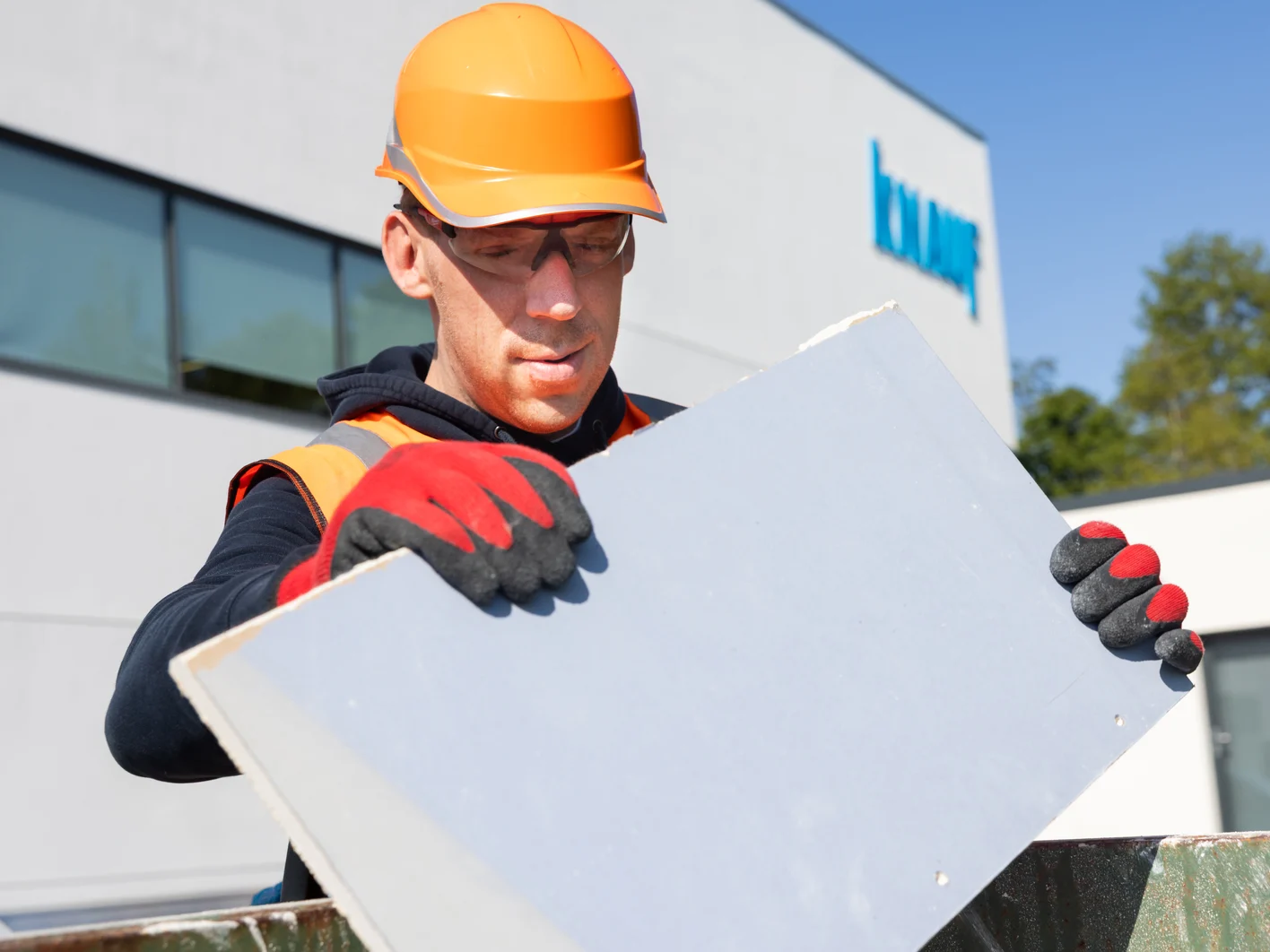
The Knauf Plasterboard Take Back Scheme offers this expertise, with our partners at Reconomy Connect delivering a fully managed, responsible take back scheme with compliant reporting data. Reconomy Connect have over 30 year's experience and know the challenges the construction industry faces, from a lack of space on site, to quick collection turnarounds needed.
Our new partnership with Reconomy Connect also adds circularity; where we work together to divert plasterboard waste back to the gypsum reprocessors we work with so that your waste can go back into new Knauf plasterboards (where it makes economical and environmental sense).
If you have any suggestions on how we can help you to reduce waste, please let us know by contacting sustainabilityuki@knauf.com.
¹ZAW-Interactive-Routemap-FINAL.pdf
²Qflow Annual Waste Report 2023